Origination Suite
Every RFP, scored against your portfolio.
A configurable, connected, integrated workspace where Origination teams scan every RFP, score the ones that fit, and brief the counterparty before writing a bid.
Operating · 240 MW solar · ERCOT West
In Near Field Energy, every pin is a live record. RFPs ingest from 12+ portals; assets sync from your pipeline registry.
One workspace, tuned to the fleet you actually operate.
Custom scoring rubrics, sourcing strategies, and pipeline definitions. Tune the AI to your portfolio, not a vendor's defaults.
RTOs, utility IRPs, corporate buyers, and bilateral inbound — surfaced and ranked alongside each other, with deduplication and counterparty intel.
AI-drafted responses mirror counterparty language and structure, grounded in the live pipeline data your originators already work in.
Every RFP, scored against your portfolio.
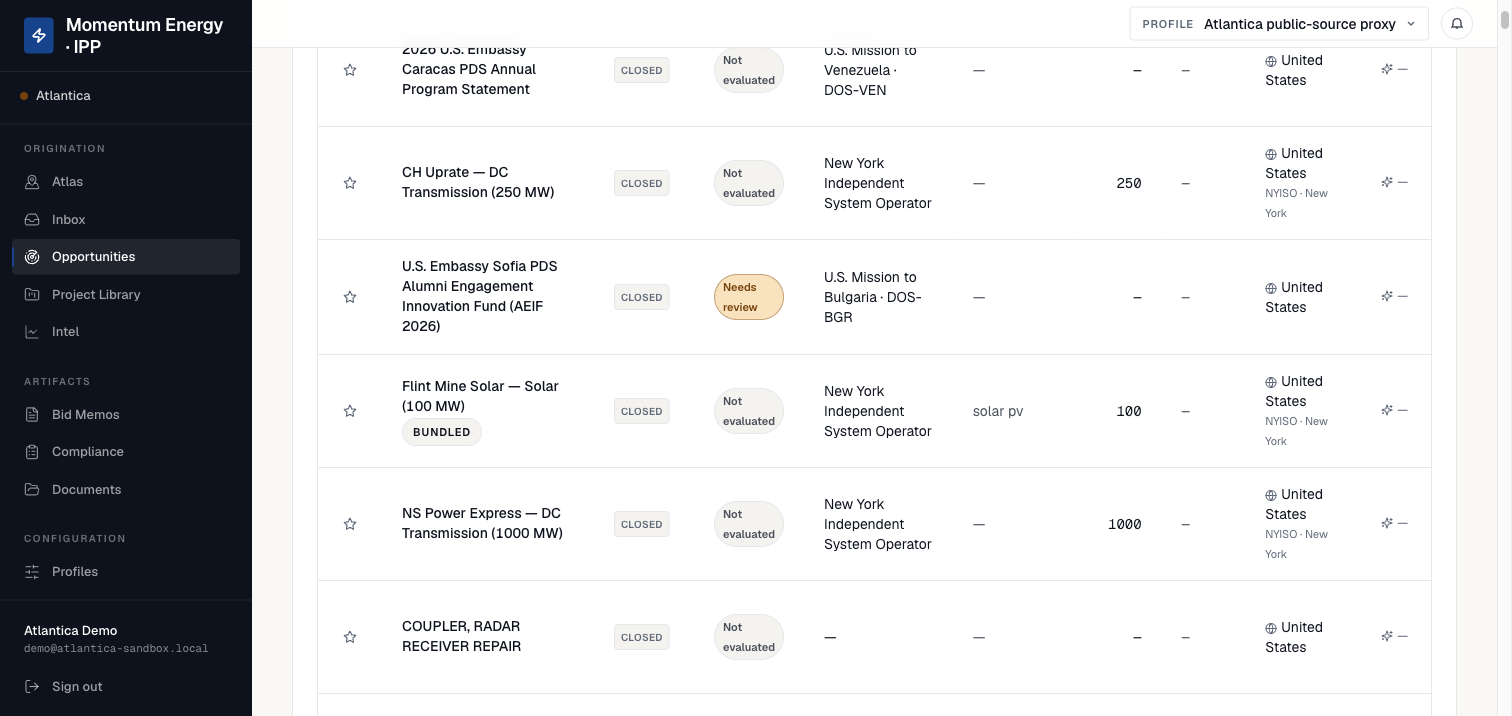
Live RFPs get filtered by deal-size, technology, jurisdiction, and counterparty fit before originator review. AI ranks the queue against your operating assets and your development pipeline — so the calls you make on opportunities are calls about real fit, not coverage gaps.
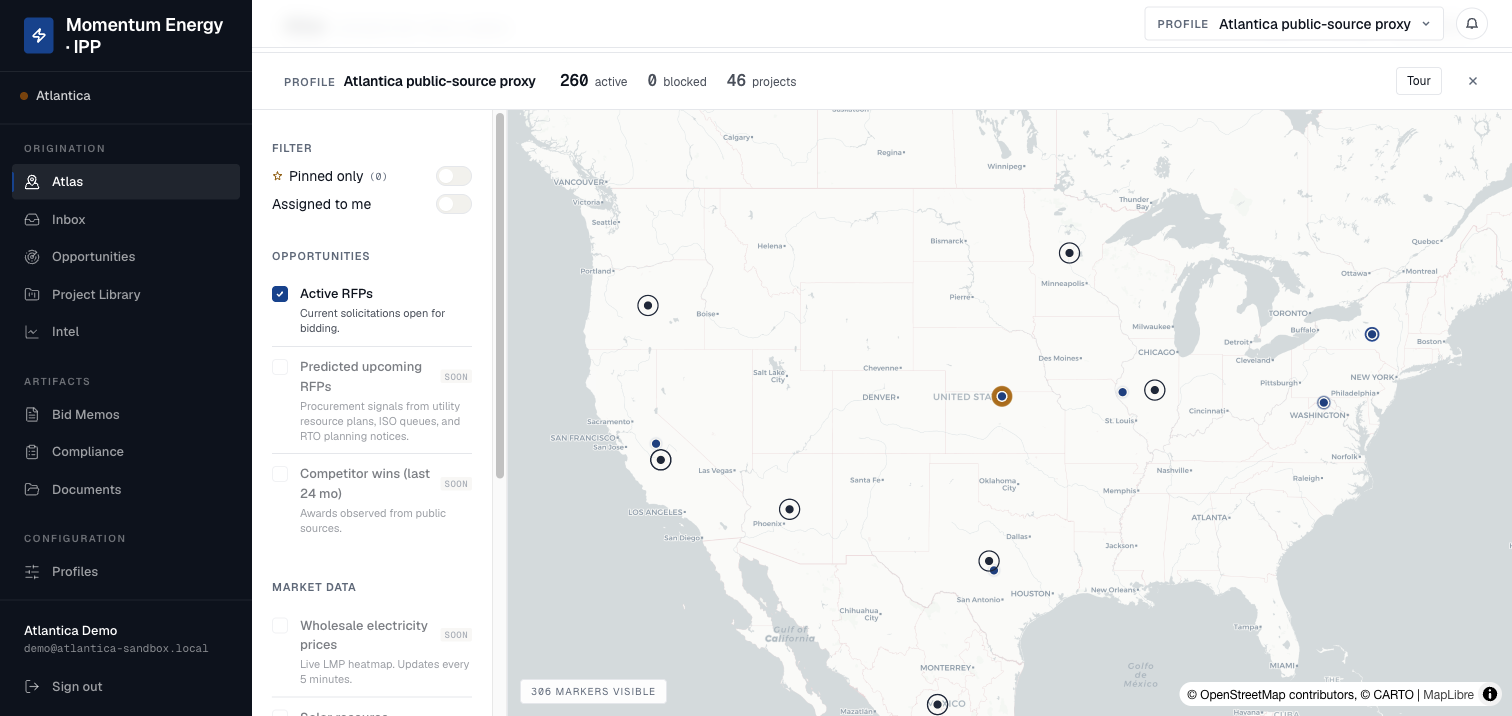
See your portfolio and the market on one map.
Pin operating assets and development-pipeline projects. Layer in live RFP markers, interconnection queue status, and recent award data. Spot the deals that fit a project geographically before scoring them quantitatively.
Geographic. Technical. Commercial.
Every opportunity is scored on three independent axes. Each surfaces a different decision.
Project siting, interconnection queue, jurisdictional eligibility. Surfaces structural mismatches before bid prep starts.
Technology, capacity, term, REC treatment. Maps the RFP's asset profile against your operating and development portfolio.
Counterparty intel, recent award patterns, credit posture. Surfaces presumptive winners and biased criteria.
Four ways the Origination Suite changes the deals you book.
Capture more viable RFPs
Year 1 contribution margin from increased pipeline coverage.
Originators scan ~12 portals manually across RTOs, utility IRPs, corporate buyer aggregators, and bilateral inbound. Coverage gaps are normal.
Near Field surfaces relevant RFPs across all 12+ portals automatically, filters by deal-size, technology, and counterparty fit before originator review, and captures inbound bilateral opportunities alongside structured RFPs.
Improve win rate on bids you make
Year 1 contribution margin from improved positioning.
PPA win rates are dominated by structural factors — price, project siting, interconnection queue position, credit. Software doesn't move those. What it moves is bid quality.
Near Field delivers counterparty intelligence on offtaker priorities and recent deal patterns, AI-drafted bid responses that mirror counterparty language and structure, and fit-scoring that focuses originator energy on the bids you can actually win.
Avoid bid spend on losing efforts
Real cash bid-prep spend avoided. A P&L line item, not a theoretical saving.
Every substantive PPA bid burns $25K–$50K in real cash — legal review, financial modeling, technical specs, originator hours. Pursuing the wrong bid isn't just a missed win; it's $25K–$50K out the door for nothing.
Fit-scoring flags structural mismatches before bid prep starts. Counterparty intelligence reveals when an RFP has a presumptive winner or biased criteria. Faster bid/no-bid decisions free originators to focus on the wins that matter.
Redeploy originator capacity
Capacity that gets pushed back into pipeline coverage and bid quality.
Originators spend 5–10 hours per week on RFP ingestion, fit scoring, bid drafting, and counterparty research. At a fully loaded $200/hour cost, a team of five sinks ~$375K of theoretical capacity into work AI can do faster.
Near Field automates RFP ingestion and initial scoring, pre-drafts bid responses tailored to counterparty, and centralizes pipeline visibility across the team.
A leverage system for your revenue team.
Not a cost tool. Not a data tool. Near Field gives your origination team measurable leverage on the deals that move your P&L — both the ones you'd otherwise miss and the ones you'd otherwise waste prep on.
See it in action.
Thirty minutes. We’ll walk you through the Origination Suite end to end and answer questions on how it fits the way your team works.